

Abstract
Training data as a capability map.
How does a language model learn to interpret people's beliefs, emotions, intentions, and everyday moral choices? We trace that ability back to the training text that taught it: scoring influence across topic and format categories, reading the language of the highest-influence text, and confirming causally with unlearning. We expand the pipeline to a broad range of capabilities such as theory of mind, moral judgment, and social bias, as well as across multiple open models.
Method
From documents to interpretable corpus regions.
The central move is aggregation: every benchmark query is traced back to many individual documents, then summarized into comparable topic-format regions.
The core tool
What is an influence function?
The model answered a question correctly. Which parts of its training data taught it that? An influence function estimates how the model's answer would change if one training document had been left out, without retraining the model.
During training, every document nudges the model's internal settings a little. A benchmark question also defines a direction: what would make the model better at this? Documents whose nudge points the same way have positive influence: they supported the skill. Documents whose nudge points the opposite way score negative.
Corpus taxonomy
24 topics crossed with 24 formats.
The corpus is de-duplicated and every document is labeled by what it is about (topic) and what kind of writing it is (format), using an off-the-shelf taxonomy (WebOrganizer). That gives 576 topic-format bins, and the highlighted cells are illustrative examples. Sampling evenly across the occupied bins turns attribution from a document retrieval problem into a structured corpus comparison problem.
Contrastive design
Domain and capability type are separated.
The 2 by 2 design asks whether social reasoning is merely social-domain knowledge, or whether reasoning tasks use different corpus regions than knowledge tasks in the same domain.
Findings
Different capabilities, different data distributions.
Core finding: each capability draws support from its own distribution of training text, not one shared pile.
Figure 2: topic and format attribution profiles
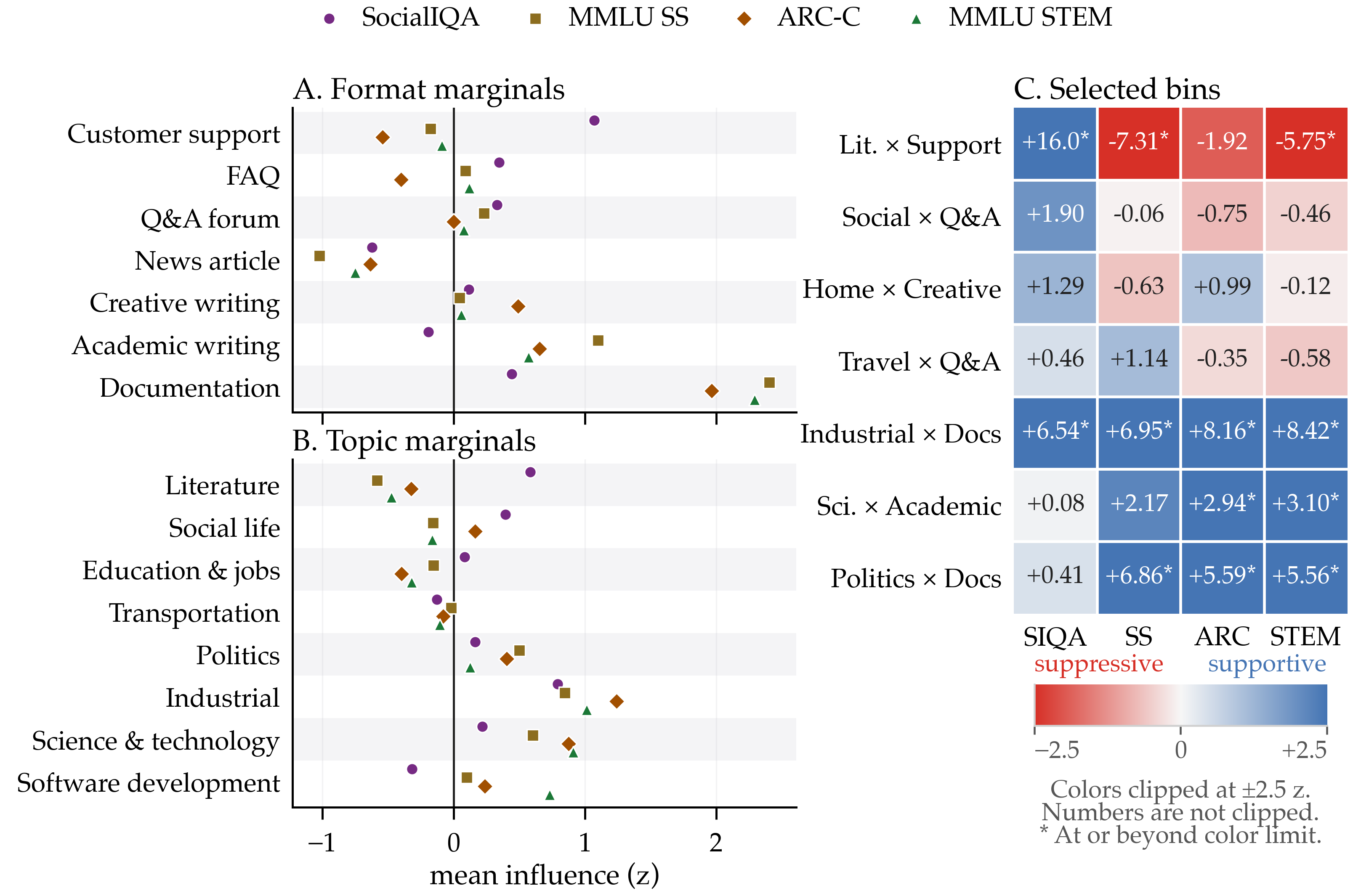
The signature in OLMo3
Two flavors of text carry social reasoning.
Social reasoning's influence profile across the 576 corpus bins looks unlike the profiles of STEM reasoning and the two knowledge tasks, which closely resemble one another. And the social-versus-STEM contrast is wider for the reasoning pair than for the knowledge pair, while leaning the same direction in both.
Read the high-influence text and it comes in two flavors: interactional writing (dialogue, questions and answers, lots of "you" and "I") and expository writing about how people deal with each other, such as guides and manuals. STEM reasoning draws instead on structured, technical text. The claim that travels is the shape of the distribution, not any single corpus slice.
interactional writing
Q&Areplyadvicefeelingsintentpeople-centered documentation
guideproceduremanualpolicysupportReasoning versus knowledge
The split is sharper for reasoning.
Knowledge tasks ask the model to retrieve facts about a domain. Reasoning tasks ask it to work over one. The two stress different training text. Measured by the strongest topic-level influence differences (|Δz|) in OLMo3, the social-minus-STEM contrast is about 1.4 times wider for the reasoning pair than for the knowledge pair, while leaning the same direction in both.
At the topic level, reasoning leans social on literature and education and leans STEM on science & technology and software development. In this controlled 2 by 2 design, capability type differentiates corpus provenance more than domain does.
The causal check
Forget the flagged text and the skill fades.
Correlation alone does not prove the flagged text matters. So we make the model unlearn the high-influence regions and compare against unlearning randomly chosen documents from the same topics. In OLMo3, influence-targeted forgetting damages social reasoning far more than the random controls, while the effect on the other benchmarks is weak or absent. The chart ranks the topics where that gap is largest.
The check validates corpus regions in aggregate, not individually causal documents. Which benchmark carries the effect can shift with the training corpus. The benchmark-specific selectivity is what repeats.
Data
Fully open.
The study is possible because the OLMo ecosystem opens every layer of the stack.
Expansion
Beyond one social skill.
Social reasoning is not one thing. A held-out suite of probes runs through the same attribution pipeline, testing how far the social reasoning lens extends across the social space.
Generalization
Beyond one model.
The same measurements are being re-run across a family of open-data models: different corpora, different token budgets, same question. Which specific regions carry a skill can shift with the corpus. The separation between capability distributions is the pattern we test for.
| Model | Training corpus | Scale | Status |
|---|---|---|---|
| OLMo3 Base | Dolma3 | 7B | Primary study |
| OLMo3 Instruct | Dolma3 + post-training | 7B | In progress |
| Marin | Open mixture | 8B | In progress |
| DCLM | DCLM-Baseline | 7B | In progress |
| Comma | Common Pile | 7B | In progress |
| OLMo3 Base | Dolma3 | 32B | Planned |
| Marin | Open mixture | 32B | Planned |
Citation
Cite the paper.
@inproceedings{matlin2026capabilityprovenance,
  title         = {Capability Provenance in Language Models: A Case Study in Social Reasoning},
  author        = {Glenn Matlin and Chandreyi Chakraborty and Saehee Eom and Mika Okamoto and
                   Rayan Castilla and Louis Jaburi and Alvin Deng and Taywon Min and
                   Lucia Quirke and Stella Biderman and Mark Riedl},
  booktitle     = {Proceedings of the Conference on Language Modeling (COLM 2026)},
  year          = {2026},
  eprint        = {2606.19625},
  archivePrefix = {arXiv},
  primaryClass  = {cs.CL},
  url           = {https://arxiv.org/abs/2606.19625}
}